
Best Time to Sell a GPU in 2026: A Data-Driven Guide to Maximum Resale Value
Why GPU Timing Matters More Than You Think
Timing is everything when selling a graphics card. Sell at the wrong moment and you could leave hundreds of dollars on the table. Sell at the right moment and you fund your upgrade before prices drop further. This guide breaks down exactly when to sell your GPU — by season, by GPU generation cycle, and by market signals — so you get the best price possible.
Consumer GPU resale values can drop 40–50% within 12 months of a new generation launch. That's not a small difference — on a high-end card like an RTX 4090, that's the difference between getting $1,400 and getting $700 for the same card.
Understanding the GPU market cycle is the single most important factor in maximizing what you get for your card.
The GPU Generation Cycle: Your Master Timing Guide
NVIDIA and AMD both follow roughly an 18–24 month release cycle for new GPU architectures. Each new generation deprecates the previous one almost immediately upon announcement — even before the new cards ship.
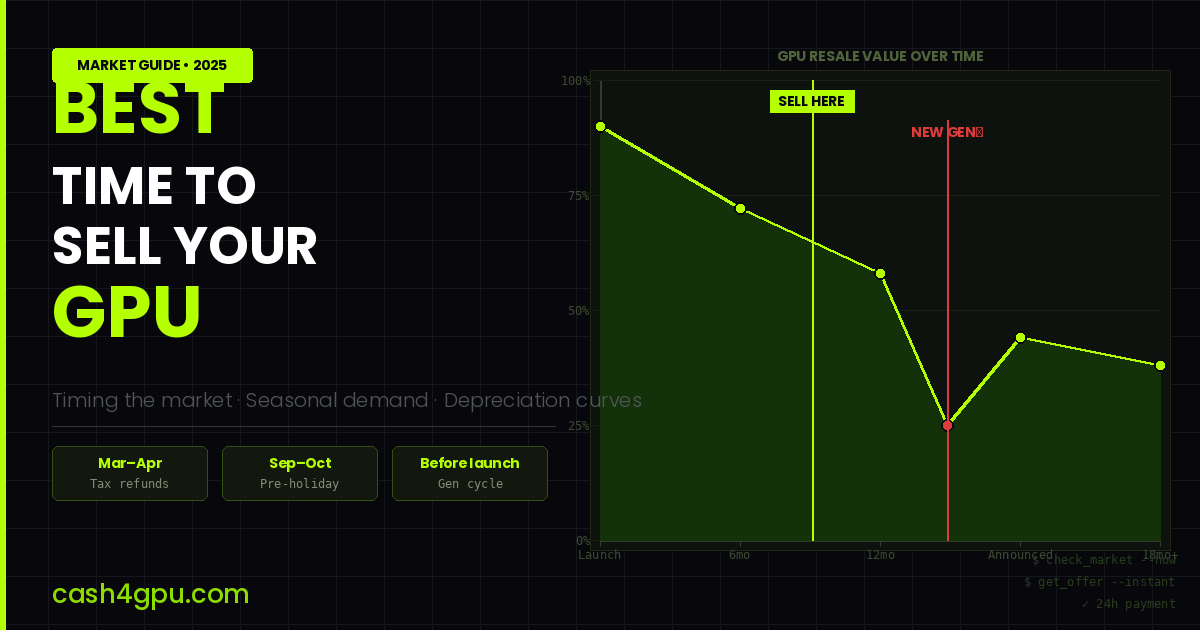
The golden rule: Sell before the announcement, not after.
Here's how the value curve typically looks:
Timing Resale Value (relative to launch price)
0–6 months after launch
80–90%
6–12 months after launch
60–75%
New generation announced
Sharp drop begins
New generation launches
40–55%
18+ months old
30–45%
The sharpest drop happens in the weeks around a new generation announcement. Buyers start waiting for the new cards, demand for older models collapses, and prices fall fast.
Practical example with RTX 4090: When NVIDIA announced the RTX 5090 in early 2025, RTX 4090 prices on the secondary market fell significantly within weeks. Sellers who listed the day before the announcement got significantly more than those who waited a month.
Best Months to Sell a GPU
Beyond the generation cycle, seasonality plays a real role in GPU demand.
January — Strong
Post-holiday period often brings motivated buyers who received gift money or want to spend holiday cash. Inventory on the secondary market is lower after the holiday rush, so prices hold up well.
March–April — Very Strong
Tax refund season is one of the best-kept secrets in GPU resale. When buyers have extra cash in hand, discretionary purchases like graphics card upgrades spike. Demand increases, which means you can price higher and still sell quickly.
May–August — Slower
Summer is typically quieter for GPU sales. School is out, people are traveling, and PC upgrade activity dips. Not a terrible time to sell, but not optimal either.
September–October — Strong
This is the lead-up to the holiday buying season and major tech events like CES announcements. Buyers want to upgrade before prices go up or before new stock sells out. It's a reliable high-demand window every year.
November–December — Good but Competitive
Holiday demand is real, but so is the supply of new GPUs hitting the market. New buyers are often targeted by retailers with Black Friday deals, which can pull some demand away from the secondary market. Sell earlier in November to catch the demand before retail sales compete.
Market Signals That Tell You to Sell Now
Sometimes the calendar matters less than what's happening in the market. Watch for these signals:
1. A New GPU Generation Is Rumored or Announced
The moment credible leaks appear (usually 3–6 months before launch), demand for the outgoing generation softens. Don't wait for the official launch — sell when the rumors start.
2. Your Card's Price Has Stabilized or Is Declining on eBay
Check completed sales (not just listings) on eBay for your specific model. If the sold prices have been flat or dropping for 4–6 weeks, you're in a depreciation trend. Sell before it accelerates.
3. Cryptocurrency Mining Demand Drops
Historically, crypto mining has driven secondary GPU demand. When mining profitability drops, miners sell their cards, flooding the secondary market and pushing prices down. If you see news of a crypto downturn, it may be time to act.
4. A Major New Game or AI Application Launches
Surprisingly, a blockbuster new game or AI tool that demands more GPU power can spike demand for mid-range and high-end cards. Sell into that demand surge.
When NOT to Sell
Avoid these scenarios if you can:
Should You Sell Now or Wait?
Use this quick framework:
Sell now if:
Wait if:
How to Sell Your GPU Quickly at the Right Price
Once you've decided the timing is right, execution matters. Here's the fastest path to getting paid:
1. Check real sold prices, not asking prices. On eBay, filter for "Sold listings" to see what buyers actually paid — not what hopeful sellers are asking.
2. Get a professional offer first. Before listing anywhere, submit your card to Cash4GPU for a free, no-obligation offer. It takes 2 minutes and gives you a guaranteed floor price. You can always try to do better on eBay, but you'll know your minimum.
3. Don't wait for the perfect price. A GPU depreciates every day it sits unused. If you get a fair offer today, take it. The $50 you might squeeze out by waiting two more weeks rarely justifies the depreciation risk.
4. Factor in fees and hassle. eBay charges 12–15% in fees. PayPal adds another cut. Buyers sometimes demand refunds. A direct buyer like Cash4GPU charges no fees and pays within 24 hours of receiving your card.
2026 GPU Market: What's Happening Right Now
The GPU market in 2026 is shaped by two major forces:
NVIDIA RTX 5000 series launched in early 2025, pushing RTX 4000 series prices down. If you're holding a 4090, 4080, or 4070, the window to sell at premium prices is narrowing.
AI demand is keeping high-VRAM cards valuable. Cards with 16GB+ VRAM (RTX 4090, RTX 4080, A-series workstation cards) are being bought by AI developers and researchers, not just gamers. This is creating a floor under prices that wouldn't exist in a pure gaming market.
The bottom line for 2026: If you have an RTX 4000 series card, sell sooner rather than later. If you have a workstation card with 24GB+ VRAM, demand remains strong and you have more flexibility.
Frequently Asked Questions
What's the best month to sell a GPU? March–April (tax refund season) and September–October (pre-holiday) are historically the strongest months for GPU resale demand.
How much does a GPU lose in value per year? On average, consumer GPUs lose 20–30% of their value annually under normal conditions, but can drop 40–50% in the 12 months following a new generation launch.
Is it worth selling my GPU now or should I wait? If your card is more than 12 months old and a new NVIDIA or AMD generation has launched or been announced, sell now. Waiting rarely recovers the depreciation you'll lose.
Where is the best place to sell a used GPU? For speed and guaranteed payment, a specialist buyer like Cash4GPU is the best option. For maximum potential price (with more risk and effort), eBay or Reddit Hardware Swap are alternatives.
Does condition matter when selling a GPU? Yes — a clean, tested card in working condition fetches 20–40% more than one with visible wear or unknown history. Clean your card before selling.
Get Your Offer Today
Don't let your GPU depreciate while you wait for the "perfect" time. The best time to sell is when you have a fair offer and a card you're no longer using daily.
Submit your GPU to Cash4GPU and get a free offer in minutes →
Free shipping. Fast payment. No fees. We buy gaming cards, workstation GPUs, and bulk lots.
Why GPU Timing Matters More Than You Think
Timing is everything when selling a graphics card. Sell at the wrong moment and you could leave hundreds of dollars on the table. Sell at the right moment and you fund your upgrade before prices drop further. This guide breaks down exactly when to sell your GPU — by season, by GPU generation cycle, and by market signals — so you get the best price possible.
Consumer GPU resale values can drop 40–50% within 12 months of a new generation launch. That's not a small difference — on a high-end card like an RTX 4090, that's the difference between getting $1,400 and getting $700 for the same card.
Understanding the GPU market cycle is the single most important factor in maximizing what you get for your card.
The GPU Generation Cycle: Your Master Timing Guide
NVIDIA and AMD both follow roughly an 18–24 month release cycle for new GPU architectures. Each new generation deprecates the previous one almost immediately upon announcement — even before the new cards ship.
The golden rule: Sell before the announcement, not after.
Here's how the value curve typically looks:
Timing Resale Value (relative to launch price)
0–6 months after launch
80–90%
6–12 months after launch
60–75%
New generation announced
Sharp drop begins
New generation launches
40–55%
18+ months old
30–45%
The sharpest drop happens in the weeks around a new generation announcement. Buyers start waiting for the new cards, demand for older models collapses, and prices fall fast.
Practical example with RTX 4090: When NVIDIA announced the RTX 5090 in early 2025, RTX 4090 prices on the secondary market fell significantly within weeks. Sellers who listed the day before the announcement got significantly more than those who waited a month.
Best Months to Sell a GPU
Beyond the generation cycle, seasonality plays a real role in GPU demand.
January — Strong
Post-holiday period often brings motivated buyers who received gift money or want to spend holiday cash. Inventory on the secondary market is lower after the holiday rush, so prices hold up well.
March–April — Very Strong
Tax refund season is one of the best-kept secrets in GPU resale. When buyers have extra cash in hand, discretionary purchases like graphics card upgrades spike. Demand increases, which means you can price higher and still sell quickly.
May–August — Slower
Summer is typically quieter for GPU sales. School is out, people are traveling, and PC upgrade activity dips. Not a terrible time to sell, but not optimal either.
September–October — Strong
This is the lead-up to the holiday buying season and major tech events like CES announcements. Buyers want to upgrade before prices go up or before new stock sells out. It's a reliable high-demand window every year.
November–December — Good but Competitive
Holiday demand is real, but so is the supply of new GPUs hitting the market. New buyers are often targeted by retailers with Black Friday deals, which can pull some demand away from the secondary market. Sell earlier in November to catch the demand before retail sales compete.
Market Signals That Tell You to Sell Now
Sometimes the calendar matters less than what's happening in the market. Watch for these signals:
1. A New GPU Generation Is Rumored or Announced
The moment credible leaks appear (usually 3–6 months before launch), demand for the outgoing generation softens. Don't wait for the official launch — sell when the rumors start.
2. Your Card's Price Has Stabilized or Is Declining on eBay
Check completed sales (not just listings) on eBay for your specific model. If the sold prices have been flat or dropping for 4–6 weeks, you're in a depreciation trend. Sell before it accelerates.
3. Cryptocurrency Mining Demand Drops
Historically, crypto mining has driven secondary GPU demand. When mining profitability drops, miners sell their cards, flooding the secondary market and pushing prices down. If you see news of a crypto downturn, it may be time to act.
4. A Major New Game or AI Application Launches
Surprisingly, a blockbuster new game or AI tool that demands more GPU power can spike demand for mid-range and high-end cards. Sell into that demand surge.
When NOT to Sell
Avoid these scenarios if you can:
- Right after a new generation launches. Prices are in freefall as buyers wait to see benchmarks and sellers panic-dump old stock.
- During a crypto crash. Former mining cards flood the market at steep discounts, dragging all GPU prices down.
- In the summer doldrums (June–August) if you can wait for September.
- Immediately after a price cut on new cards. If NVIDIA or AMD drops the MSRP on their new GPUs, used prices follow downward.
Should You Sell Now or Wait?
Use this quick framework:
Sell now if:
- Your card is 12+ months old and a new generation is coming within 6 months
- You've seen 3+ consecutive weeks of price drops on completed eBay sales
- You don't need the GPU for daily use
Wait if:
- Your card is less than 6 months old and no new generation has been announced
- Tax refund season (March–April) is approaching and you can hold a few weeks
- GPU prices in your category are actively rising due to supply shortages
How to Sell Your GPU Quickly at the Right Price
Once you've decided the timing is right, execution matters. Here's the fastest path to getting paid:
1. Check real sold prices, not asking prices. On eBay, filter for "Sold listings" to see what buyers actually paid — not what hopeful sellers are asking.
2. Get a professional offer first. Before listing anywhere, submit your card to Cash4GPU for a free, no-obligation offer. It takes 2 minutes and gives you a guaranteed floor price. You can always try to do better on eBay, but you'll know your minimum.
3. Don't wait for the perfect price. A GPU depreciates every day it sits unused. If you get a fair offer today, take it. The $50 you might squeeze out by waiting two more weeks rarely justifies the depreciation risk.
4. Factor in fees and hassle. eBay charges 12–15% in fees. PayPal adds another cut. Buyers sometimes demand refunds. A direct buyer like Cash4GPU charges no fees and pays within 24 hours of receiving your card.
2026 GPU Market: What's Happening Right Now
The GPU market in 2026 is shaped by two major forces:
NVIDIA RTX 5000 series launched in early 2025, pushing RTX 4000 series prices down. If you're holding a 4090, 4080, or 4070, the window to sell at premium prices is narrowing.
AI demand is keeping high-VRAM cards valuable. Cards with 16GB+ VRAM (RTX 4090, RTX 4080, A-series workstation cards) are being bought by AI developers and researchers, not just gamers. This is creating a floor under prices that wouldn't exist in a pure gaming market.
The bottom line for 2026: If you have an RTX 4000 series card, sell sooner rather than later. If you have a workstation card with 24GB+ VRAM, demand remains strong and you have more flexibility.
Frequently Asked Questions
What's the best month to sell a GPU? March–April (tax refund season) and September–October (pre-holiday) are historically the strongest months for GPU resale demand.
How much does a GPU lose in value per year? On average, consumer GPUs lose 20–30% of their value annually under normal conditions, but can drop 40–50% in the 12 months following a new generation launch.
Is it worth selling my GPU now or should I wait? If your card is more than 12 months old and a new NVIDIA or AMD generation has launched or been announced, sell now. Waiting rarely recovers the depreciation you'll lose.
Where is the best place to sell a used GPU? For speed and guaranteed payment, a specialist buyer like Cash4GPU is the best option. For maximum potential price (with more risk and effort), eBay or Reddit Hardware Swap are alternatives.
Does condition matter when selling a GPU? Yes — a clean, tested card in working condition fetches 20–40% more than one with visible wear or unknown history. Clean your card before selling.
Get Your Offer Today
Don't let your GPU depreciate while you wait for the "perfect" time. The best time to sell is when you have a fair offer and a card you're no longer using daily.
Submit your GPU to Cash4GPU and get a free offer in minutes →
Free shipping. Fast payment. No fees. We buy gaming cards, workstation GPUs, and bulk lots.